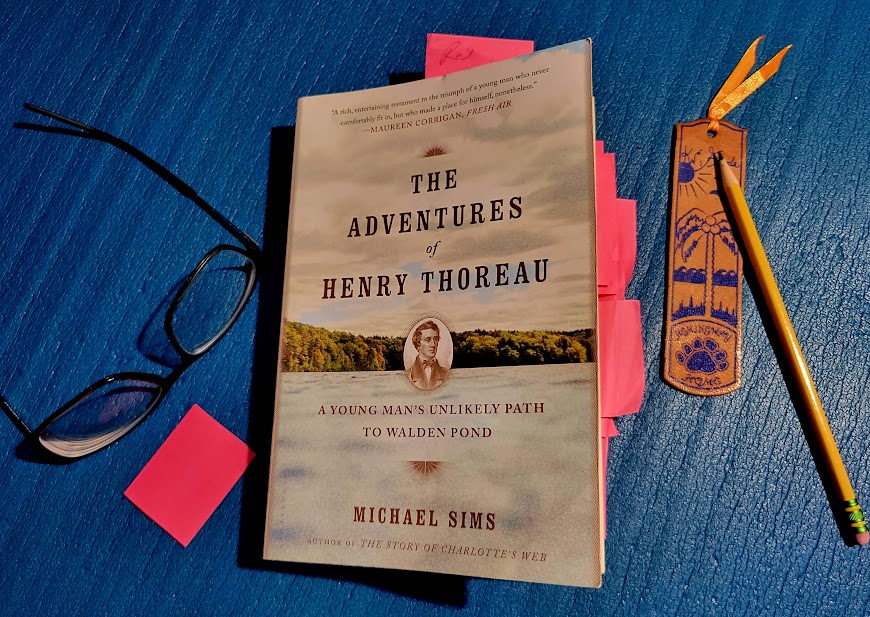
What inspired the young Henry Thoreau to build a cabin on Walden Pond in his late 20s and live a long-dreamed-of life there … and what drove him to abandon it after a little more than two years? My longtime friend Michael Sims answers these intriguing questions in this wonderful biography.
The Adventures of Henry Thoreau: A Young Man’s Unlikely Path to Walden Pond is a beautiful, touching book that brings one of our country’s most enigmatic characters to vivid life, with a focus on his formative years.
As Michael writes, the book explores how “a quirky but talented man named Henry evolves into an original and insightful writer named Thoreau.”
I’m embarrassed to say I’m just getting around to reading the biography (it was published in 2014). It’s about time … because the book is filled with some of the most gorgeous, lively prose I’ve ever read. For any writer, it’s a book worth studying … and returning to again and again. (Hence my sticky notes poking like porcupine quills from the pages of the book in the photo above.)
The quality of the book comes as no surprise.
Michael is the most-published author I know, his many non-fiction books brimming with intellect, wit and the sheer joy of exploring a good mystery—whether it’s the miracle of the human body in Adam’s Navel: A Natural and Cultural History of the Human Form (a New York Times Notable Book), the astonishing beginnings of mammals in National Geographic’s In the Womb, or the origins of a world masterpiece in The Story of Charlotte’s Web.

Love of the mystery has also inspired Michael to edit elegant collections of Victorian detective and vampire stories. You can find out more about all his books on this Publishers Weekly page.
With an impressive career that spans over 25 years, Michael is a bit of an enigma himself. A native of rural Crossville, Tennessee, he never went to college. Yet he’s one of the most scholarly people I know. You’d think he’d have a string of degrees trailing after his name. And his prose is among the most erudite I’ve ever read. Erudite AND engaging, entertaining, fun. That’s the mark of a great writer.
He is at the height of his powers as he explores the American oddity that was Henry Thoreau.
What made Henry tick?
As Michael shows us, Henry wasn’t an easy young man to like. He bailed on a promising teaching career. He set the woods on fire near his hometown, struggled to get his writing published, seemed just plain strange to many.
But Michael makes him likeable in all his idiosyncracies. He shows that Thoreau was a misfit for a reason, keeping his focus beyond ordinary life to a higher purpose. As Michael writes: “People had been raising their eyebrows at his (Thoreau’s) antics for his whole life, however, and most of the time he took their surprise as a testament to his extraordinary virtues.”
He was indeed a man on his own path. And what a path it was. A path that led Henry to influence the likes of Gandhi and Martin Luther King, who cited Thoreau’s 1849 essay, “Civil Disobedience,” as his first exposure to the theory of nonviolent resistance.
The Adventures of Henry Thoreau is an American history lesson.
In addition to his vibrant portrait of Thoreau, Michael paints a finely detailed portrait of early 19th century life in Concord, Massachusetts, when friction matches, pencils and schoolroom blackboards were modern technological advances.
It’s a pleasure to meet Ralph Waldo Emerson, Nathaniel Hawthorne and other contemporaries of Thoreau. We grieve with Henry over the loss of his brother, John, who died an agonizing death from lockjaw in 1842 at age 27. We marvel at his writing talent, so clearly evident in the journal he started at Emerson’s urging at age 20. “The snow gives the landscape a washing day appearance,” he wrote.
Henry could cook, too.
My favorite part of the book comes when Michael takes us inside Henry’s cabin at Walden Pond. In the delightful chapter “Luncheon at the Cabin,” Henry invites a childhood friend for a meal with homemade bread, beans, corn and fresh-caught fish fillets baked on hot stones around his fire pit.
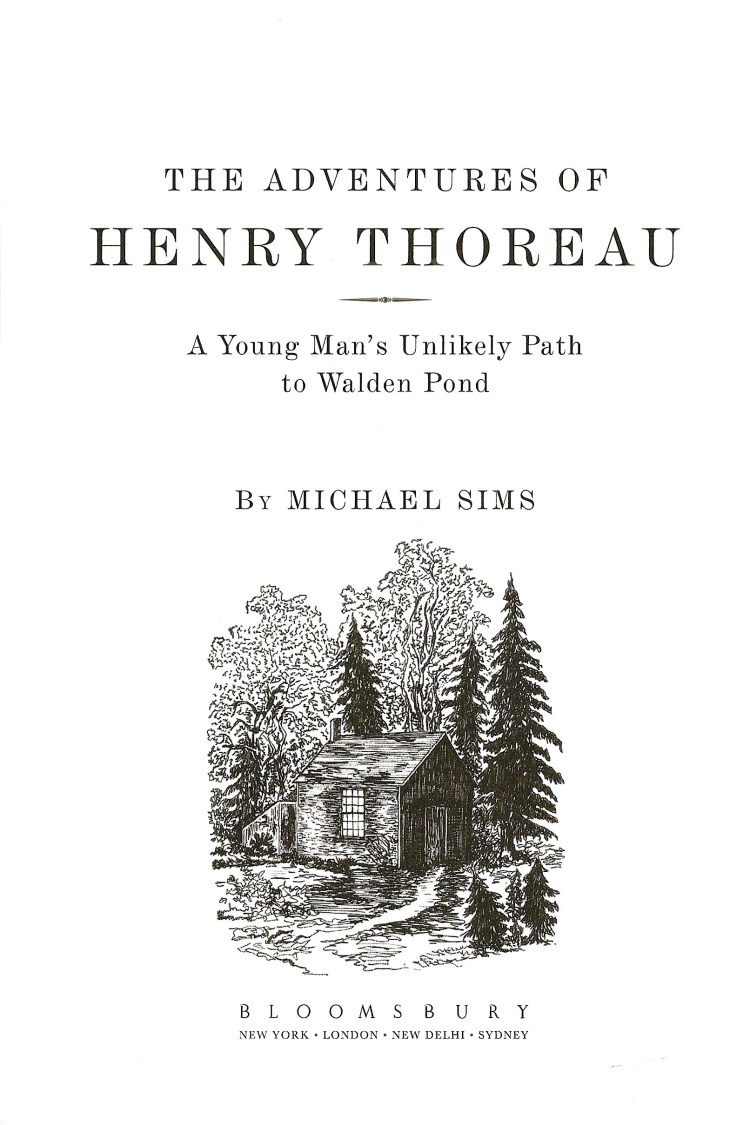
When the friend puts the modest menu on paper, Henry stays true to his literate, Harvard-educated self by translating his friend’s English to Latin, French and Greek.
And if you’ve ever wondered what it was like to live at Walden, here’s one of Michael’s descriptions that puts us right there:
“Each night Henry went to sleep in his own bed, listening to the crickets and bobwhites and owls, with the train’s occasional dragon roar at the other end of the pond. Mornings found sunlight angling not across pine trunks but through the cabin’s open door, warming not vegetable mold but the planed boards underneath his green desk. The pitch pines whose aromatic roots had slowed his digging of the cellar now rubbed their needled branches across the roof.”
Wow. Just wow.
Michael’s skill as a writer also shines through in a later chapter, when Henry’s awe and panic on a harrowing mountain hike in Maine led to his epiphany that “wilderness alone was not enough,” as Michael describes it. The experience prompted Henry to move out of the cabin at Walden and return to his family’s home in Concord.
He lived in the village for the remaining 15 years of his life and, during that time, visited Walden Pond almost daily. It’s heartening to know that.
It’s also bittersweet to be reminded that Henry died so young … at 44. But what a legacy he left us.
And what a gift Michael has given us with this book.
P.S. While Michael is keeping specifics of his next project private for now, he did tell me this much from his home in Pittsburgh:
“Having fallen in love with the early 19th century and loving every minute of writing THE ADVENTURES OF HENRY THOREAU, I have jumped across the Atlantic and I’m writing about another great naturalist, this time in London, during the same time period.”
Happy writing, Michael. We look forward to the results.

